Why is a tiny class of biological molecules now sitting smack dab in the middle of a conversation that intersects AI, trade policy, fitness, and even religious and philosophical circles?
The whole story basically starts with a single question: "What if the body is actually way more programmable than we originally thought?"
For most of human history, things like hunger, aging, recovery, and body weight were just simple facts of life. You could push and poke and prod them at the edges with good diet and sleep—or bad diet and sleep, for that matter—and things like discipline and medicine, but there were always limits.
The body always ran on a fixed set of rules.
And then, all of a sudden (and quite recently in the grand scheme of human history), the whole field of biology and biological capabilities opened way up. As it turned out, we discovered that the body runs on tiny chains of chemical messages that get passed back and forth. Cells are constantly talking to one another. One signal says to eat; another says to stop eating. Others tell your tissues to grow or heal, to store fat or burn fat, to send in the immune system, to make repairs, or to fight off unwanted intruders.
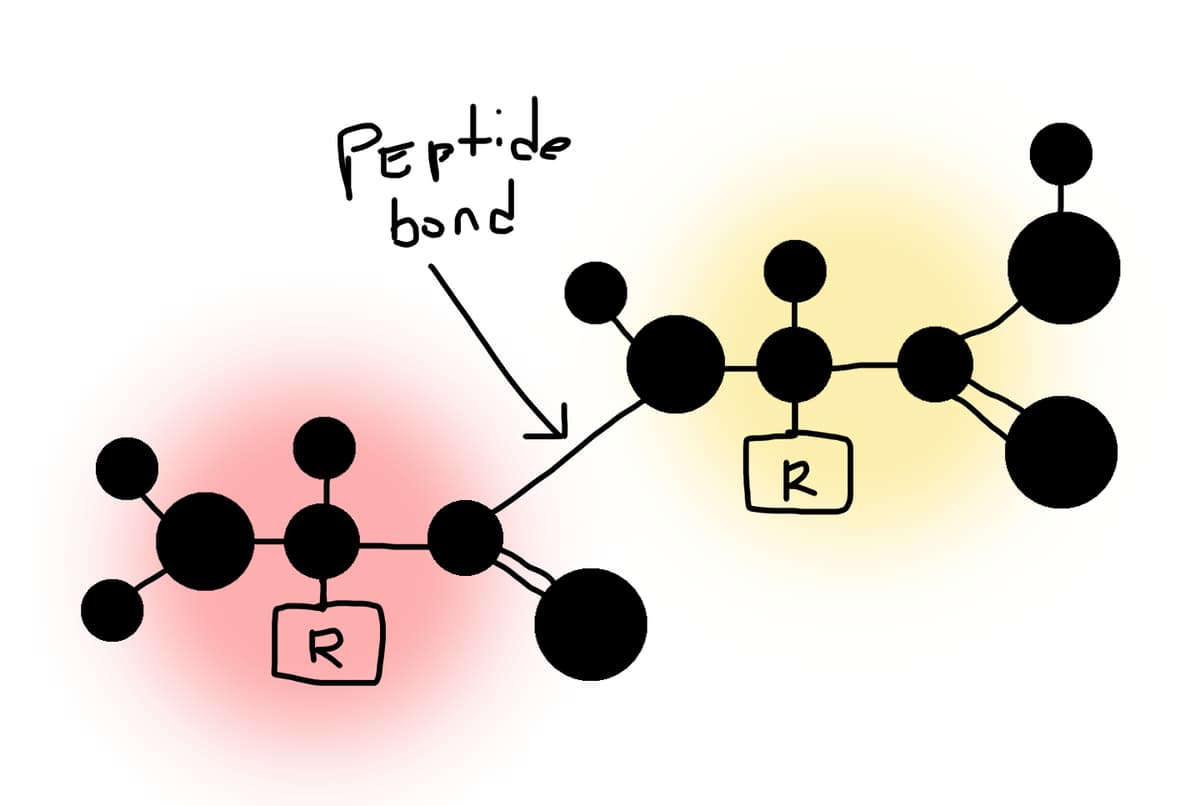
A lot of those signals ride on short chains of amino acids called peptides. These peptides are tiny biological instructions, but these tiny instructions turn out to be quite powerful. One peptide chain can tell the pancreas, for example, to release insulin (to regulate blood sugar). One can tell your brain that you are not hungry. One can tell damaged tissue to repair itself.
For decades, that tribal knowledge sort of lived inside labs and pharma R&D, but very recently the public got access to these chains of instructions to experiment and play with for themselves in the form of GLP-1 drugs.
And of course, these are absolutely everywhere now. You've probably seen names like Ozempic and Mounjaro sold as injectables and, now, even as pills. These drugs basically affect, among other things, the body's hunger circuitry. So they're massively successful and massively effective. Any normal person can now basically achieve weight loss super easily and super fast. These drugs are more or less a revolution, and they prove that a purpose-built, very tiny molecule can fundamentally change a core human experience on a large scale.
And of course, the implications go far beyond obesity treatment. For most people, GLP-1 was the first time the idea really landed in the public consciousness that biology itself is broadly editable. And of course, now that that idea is widespread in the culture, it spreads like wildfire. If hunger can be edited, what about recovery and sleep and aging and muscle gain and muscle loss and cognition and lifespan?
Now we've seen a whole ecosystem grow up around those questions, way faster than anyone at the FDA could have hoped to keep track of. If you take someone like Brian Johnson, for example, he's spending millions a year trying to see not only whether he can, but to what extent he can, extend his own lifespan, tracking every biomarker he can fund or pay a lab for. Five years ago, he would have been a viral curiosity. Now he's a whole category. This weekend there's the Enhanced Games, a sort of Olympics where PEDs are the whole point—to push the body to its absolute limits and see what we can accomplish. We see longevity startups raising billions of dollars. We see TikTok creators and streamers like Clavicular talking about peptide stacks and taking them mainstream in the same way that '90s TV talked about low-fat diets and Atkins.
And all of these seemingly unrelated stories are really driven by the same instinct: to stop treating the body as a fixed inheritance and start treating it like a tunable system.
Now, I would argue that one of the most interesting topics in this whole conversation is not about the peptides themselves, but about the underlying supply chains. And that is because modern peptide compounds are pretty brutal to manufacture. You can't just run a reaction in a vat and bottle it. Peptide synthesis happens one amino acid at a time on specialized equipment in facilities so incredibly sterile that a single contamination event can wipe out a multimillion-dollar batch. The number of facilities in the world that can do this at FDA scale is genuinely very small. And right now, companies like Eli Lilly and Novo Nordisk are consuming most of that global capacity just to keep up with demand for Mounjaro and Ozempic, respectively. So it's no wonder that there are shortages of the drugs themselves.
R&D and discovery of these molecules is one job. But making tens of millions of doses in a sterile environment and making sure every batch is identical—that is a separate job, and it is arguably the harder one.
And that is where the finance world shows up.
Institutional investors are basically asking the same question they've always asked: If everybody wants the product, who owns the infrastructure to create and distribute the product?
Think back to the early days of the AI boom, when models like GPT-3.5 and GPT-4 were coming out, chatbots were starting to have mainstream appeal, and the first wave of big VC and investment money was flowing into AI apps. Everybody pretty quickly figured out that the bottleneck was actually compute. This was different from earlier eras in software, where the bottleneck was creating the software itself. Here, the bottleneck became things like chips and data centers and the actual energy flow—the gigawatts.
Now, a few years later, we are starting to see the same thing happen in biotech. If peptide therapies keep spreading the same way, and if AI keeps accelerating drug discovery, the bottleneck becomes manufacturing capacity rather than scientific imagination, as it was in past eras.
And that is why, when you think about a topic like pharmaceutical onshoring—which on the surface sounds kind of dry and maybe siloed to a small corner of the world—it suddenly matters a lot and has tendrils in many different areas of everyday life. Governments don't want to rely on Chinese supply chains for the country's medicine; they want production at home. Investors want to know which companies own the factories, the know-how, the compliant production and distribution lines, and so forth to actually make the next decade of biotech innovation and scaling work as seamlessly as possible. So while the general public is focused on injectable GLP-1 drugs, the market is often more concerned with the building that's filling and packaging the syringes.
And AI is only going to push this even further. Most of today's AI-and-medicine conversation focuses on discovery—things like protein structure prediction, faster target screening, and more and more breakthroughs.
But all of this success creates its own problem if it is just generating more and more discoveries without a foundation to support them. If AI gets really good at finding new therapies, the choke point quickly moves. Discoveries pile up faster than clinical trials can evaluate them, and approved drugs emerge faster than facilities can produce them. So the underlying infrastructure becomes the scarce asset.
A lot of institutional eyes—and a lot of institutional money—are focused on the idea that the future will belong to whoever owns the underlying biological infrastructure.
And underneath all of this is yet another layer, another question that doesn't have a financial answer and maybe doesn't have an answer at all: What exactly are we optimizing for anyway?
As biohacking and longevity science become more mainstream, we get philosophical questions like, "If we can live longer, should we?" and "How long should we live?" These questions have, since the beginning of time, been relegated broadly to philosophy and religion, but they could easily become very mainstream questions that ordinary people ask every day in a practical, non-hypothetical context.

Peptides in drug discovery—and biotech as a whole—aren't really moral or immoral; they're more neutral tools. A peptide can help a diabetic person regulate blood sugar. It might help an obese person lose weight.
If it can help slow disease or aging, then of course those use cases are what we would generally call good. They promote human flourishing. But suppose these technologies continue improving and improving beyond that. We will start asking questions like: If we can, in a very practical sense, live longer, how much longer should we live?
If we can sharpen cognition, to what extent should we do that? Who gets access? Who gets access first?
If we can change appearance on demand, what new standards of beauty get manufactured? If we can optimize measurable traits, what happens to the traits that are not measurable—the traits that don't show up in metrics, like charisma, inventiveness, or compassion?
We have been arguing about these things for thousands of years, but it does seem like they're about to become much less abstract and much more real, much more quickly.
Long before peptides or AI or biotech, religious traditions were asking all of the same questions in slightly different vocabularies. The Bible, the Quran, the Vedas, the Book of Mormon—all of these texts don't explicitly talk about receptor binding or protein synthesis, but they do talk about power and wisdom and mortality and desire and the limits of all these things. Their concern isn't whether humans can acquire more capabilities. In fact, they frequently celebrate human creativity. Their concern is whether new capabilities arrive with the wisdom to wield them well.
So when you zoom all the way out, the peptide conversation isn't really about peptides. They're just an early chapter in a much longer story: the story of a civilization that used to treat biology as destiny and is now starting to learn how to rewrite parts of that destiny—to rewrite parts of its own operating system.
The economic consequences, of course, will be enormous and will probably rival the digital revolution. But the deepest consequences are philosophical, because for the first time, humans have tools that can systematically change traits that previous generations simply accepted as unchangeable.
Nobody alive has lived through that before.
We are about to.
It's going to be weird. It's going to be wacky. It's going to be scary. A few people are going to make a whole lot of money, and humanity as a whole is probably going to get a whole lot weirder.
I will see you on the other side.