
Let's talk about losing one's religious belief. Here's me in the spotlight (yes, I know the song lyric is a euphemism).
There is a consequence of losing one's religious belief that receives very little attention despite being one of, if not the most, practically important factors to weigh. It is the loss of community. The public argument about religion has been conducted almost entirely on metaphysical terrain. That is, God, miracles, scripture, the problem of suffering, and so on. But for many people who leave the church, the greatest loss is neither certainty about the afterlife nor a moral framework. It is the disappearance of a social institution that, almost by accident, bundles nearly every ingredient of human flourishing into one place.
It's 2026. Something like 3 in every 10 American adults now identify with no religion, up from single digits a generation ago [0]. "Nones" are now the fastest growing "religious identity" in the western world. In American Grace, Robert Putnam, who spent his career measuring American social capital, found that religiously observant Americans are more likely to give to charity (and that is, by the way, including secular charities), volunteer, join civic organizations, help strangers, and report a higher level of life satisfaction than their secular neighbors [1].
Putnam found that the effect had almost nothing to do with the belief itself. Actually, theology and intensity of conviction usually predicted very little. What predicted generosity and well-being came down to one variable: the number of close friends a person had at their church [1]. Which raises a question: can a society build an institution that fulfills the same psychological, social, moral, and existential functions as the church, without necessarily requiring belief in doctrines many people find evidentially insufficient? The historical record, which I'll talk a bit about more below, suggests an answer somewhere between Not Yet and Not Without giving up the very features that make secularism attractive.
It's not that secular people are incapable of building communities. It's also not because religion must therefore be true. Rather it is because churches solve a huge collection of human problems simultaneously. And every secular institution built so far has managed to reproduce only some subset of that package's offerings.
Emile Durkheim saw this just over a century ago. In The Elementary Forms of the Religious Life in 1912, he argued that religion is an eminently social thing. That when a congregation worships, what it is actually worshipping without knowing it is society itself, its own moral unity projected onto the cosmos. Religion, he said, is a unified system of beliefs and practices relative to sacred things which unite into one single moral community called a church [2]. Notice that his definition purposefully does not require any God or gods. What is required is the division of the world into sacred and profane and a moral community organized around maintaining that division.
This clarification that church is not necessarily centered on a God or gods matters because when modern people think about church they think about worship or belief in a God, a place where propositions are affirmed; but a healthy church is much more than that. It is a whole ecosystem. It is simultaneously a philosophy department, a counseling center, a charitable organization, a volunteer network, a daycare, a music venue, where teenagers start feeling teenager feelings for one another (been there), and so on. And for believers, the single most important thing is probably that each church in their denomination is an outpost of a cosmic purpose.
If we look at a range of secular alternatives, almost every single one reproduces one or two or maybe even a few of these functions. For example, a philosophy meetup explores ideas, the hardcore music scene builds camaraderie, a therapist encourages growth, a homeowners association encourages civic contribution (in theory) etc. Each one offers a fragment of the whole story, whereas a church offers deep social integration, and this integration, more than any definite theological claim is religion's greatest institutional achievement.
Alexis de Tocqueville noticed the same thing when he toured America in the 1830s. (Born into aristocracy, he secured an official commission to study the American penitentiary system, but...)
What he found in his travels was that in arguably the world's most individualistic society, religion functioned as "the first of their political institutions" [3] because it manufactured "the habits of the heart" rather than dictating law, and this was what made self-government possible: the reflex of association, the discipline of shared obligation, the weekly reminder that one's life entangled with others' in a much grander scheme. Tocqueville saw religious congregation as an essential counterweight to the fear that democratic individualism, left to its own devices, would create "a crowd of similar and equal men, incessantly turned in on themselves" [3]. Putnam's "Bowling Alone", put out in 2000, is the realization of this fear: as congregations empty out, and nothing of comparable binding power replaces them, we lose an essential part of community and shared communal responsibility [4].
Pop quiz: Why do people love going to church?
The answer has almost everything to do with a set of deeply human experiences that reinforce one another.
Church(es) tell(s) an enormous story: that existence does have meaning and here's the exact guidebook to finding it, and anyone can do it, even you. That history has direction, that good and evil are real, that suffering matters, and there can be redemption. Whether or not these claims are literally true, they provide churchgoers a frame in which every moment of even the most ordinary daily life can be significant.
Putting aside whether religious experiences coincide with reality, in "The Varieties of Religious Experience", William James explored instead what a religious experience does for a person; what are its first- and second-order effects. In essentially a psychological evaluation rather than a religious one, he posited that they can create an assurance of safety, a peaceful temperament, and "in relation to others, a preponderance of loving affections" [5]. Here, the fruits are real regardless of whether the roots are real. And modern research largely backs this up; perceived meaning is one of the strongest predictors of resilience (roughly Viktor Frankl's thesis in "Man's Search for Meaning"), and religion remains the most reliable industrial-scale producer of perceived meaning.
Certain religions at times frame themselves as peaceful, but rarely as passive. Believers are enlisted in the great cosmic struggle between good and evil - Us on the side of justice and liberation, Them on the side of corruption beyond saving. Jonathan Haidt describes humans as something to the effect of "mostly selfish primates, but with the capacity to organize under the right circumstances, via forced competition" (paraphrased). According to Haidt, religion is one of the greatest agonists of this "hive switch"; via shared practices like worship and sacrifice, common enemies, and sacred objects, believers can transcend self-interest [6]. The military flips the same switch, but beyond that, few cultural institutions make ordinary people feel like combatants in a war that matters, week after week, for a lifetime.
Churches don't consist of perfect people; and often that's the point - just take Christianity where that fact is a core tenet. Come as you are; the point is in trying to become better - together, over years. Members form families, kids create core memories, there are marriages, deaths, addictions and recoveries etc, all observed through the lens of intimate community. Trust accumulates through regular contact. And this is profoundly different from modern friendship, which can be transient, even digital/stretched across geo-boundaries, and generally organized around shared interests rather than shared mission/purpose/values.
Alasdair MacIntyre argued that modern moral life is incoherent because we inherited fragments of ethical vocabulary from earlier traditions whose social contexts we destroyed. For him, virtue can't exist as a distinct entity, it must exist inside of either: 1. practices (activities), 2. the narrative unity of a human life (ie a human life understood as a quest), or 3. tradition (framed here as multigenerational discussion) [7]. Churches supply all three, structured as purpose ranging from immedate to ultimate: deliver meals to a family in need, become virtuous, know God. This creates a unique directional structure that no secular institution achieves: one's philosophy of life directly drives next week's calendar. MacIntyre's closing line is a call to collectively create a new type of community in which virtue can survive the collapse of shared metaphysics [7], and four decades later, we are still waiting to see whether something like this can truly take root.
An underestimated and necessary element of religion is shared ritual - whether it's scheduled prayers, a rock concert with strobelights in a warehouse, or candlelit chants in a stained glass cathedral. Going back to Durkheim for a moment - he coined this "collective effervescence" which basically describes that palpable, self-transcending energy generated when a group moves, sings, and absorbs the vibe together - what he considered the elementary particle of all religion [2].
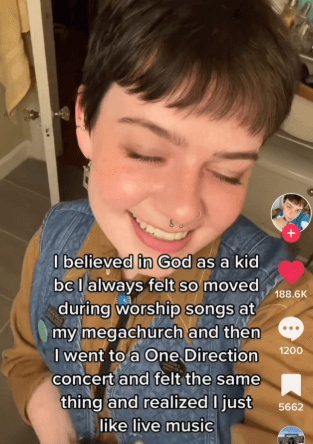
The Synchrony experiments conducted in 2009 by Scott Wiltermuth and Chip Heath demonstrated that people who merely walked in step or sang together subsequently cooperated more and were more willing to sacrifice for the good of the group dynamic, even with no shared beliefs at all [8]. Similarly, Robin Dunbar's research has shown that communal singing triggers endorphin release, creating an "icebreaker effect" that accelerates social bonding and raises pain thresholds [9]. And in "Ritual and Religion in the Making of Humanity", Roy Rappaport argued that ritual doesn't merely express the sacred, it actually manufactures it [10]. Rather than the presence of the sacred generating shared action, the reverse happens: by performing shared actions, a sense of sanctity and social contract is created which people feel bound to respect.
This is interesting in two ways. For one thing, it means, obviously, that the emotional power of worship is itself not evidence of God (though it is also not not evidence). But the other point is that the atheist who skips the singing because "it's just chemicals" has pretty much wholesale misunderstood the assignment. The chemicals are the whole point! People leave worship services feeling more connected to their community, and doing this week after week for years or decades is the cornerstone of building strong community.
When I was in my early 20s, I was a regular attendee and member of the worship team at a popular evangelical/non-denominational church in New Jersey (think Baptist, but in a warehouse with rock songs). I played drums. I loved doing this, I loved playing music (still do) - and I didn't mind that I had to haul out during the week and then again super early in the morning on Sunday for rehearsal (mind you, it was definitely not a paid gig).
I remember one Sunday we had just finished up the third service, and a family friend came up to me after the set, and gave me kudos on a great set. He said it really moved him. And then he asked me if I felt the Spirit moving me while I was playing. I answered honestly - not really, usually I'm so focused on nailing the parts and playing well, that that's all I'm really thinking about. I think that answer left him a little bit dismayed. And the interesting thing is, I always came away from playing at church having a feeling effervescence, a feeling of communal joy and camaraderie and Good Happy Brain Chemicals. I think my family friend was hoping that the sacred would move me, but really, it seems I was the one moving the sacred.
Religion, and in particular sects like Orthodox Christianity, Tibetan Buddhism and Sufism which tend to more deeply value sensory beauty as pathways to the divine, understand something that modern secular institutions tend to miss; beauty is foundational to the experience. And there is quite a body of research around the psychology of Awe - in particular, Dacher Keltner showed that awe produces something called the "small self"; diminished self-focus, increased generosity, greater willingness to affiliate and so on [11]. Of course, secular life can have awe too - think snow capped mountains, telescopes, microscopes, a really (Inter)stellar movie soundtrack - but delivers it more occasionally and privately, not weekly and collectively.
Moral formation, mutual aid, confession
Every week, church congregants are handed an actionable mandate. Forgive, be humble, resist greed, practice generosity, and strive week after week to become better version of yourself than you were yesterday. And it's more than just a discussion point or some kind of performative theater (at least in theory); it's really expected. And in times of tragedy or crisis, churches frequently mobilize faster than formal agencies in supplying aid [12]. Because churches possess relationships rather than services, that means meals, money and childcare appear quickly and without paperwork.
Healthy churches also offer a dedicated space to provide something increasingly rare in modern life: permission to admit weakness, and a normalization of saying "I am struggling, I failed, I have addictions, I'm a broken person, I need help". Communities become more resilient when vulnerability is valued. In fact, the single most successful quasi-secular congregation in recent history was built almost entirely on this one feature. We'll talk more about this (AA) in just a bit.
Why secular communities fail: spoiler, it's Obligation.
What do run clubs, A.I. meetups, and the (RIP) Bamboozle music festival all have in common? Each one captures something valuable; most dissolve within months or years. The reason is not that they lack God. It is that they lack obligation. Attendance is optional, participation consumeristic, and the social glue reduces to "I'll show up if I feel like it". Communities survive when they become all-encompassing identities, not just hobbies, and ultimately identity is forged in what the community asks of you consistently, not just what it can offer.
In the 1800s, hundreds of US communes sprung up, some of them religious (Shakers, Oneida, Amana) and some secular (Owenite, Fourierist socialist). Anthropologists Richard Sosis and Eric Bressler found that the religious communes were far more durable; in any given year, they were roughly four times more likely to survive than any secular counterpart [13]. And checking back on these same communities 20 years after their founding, most secular ones vanished while most religious ones were still going strong. And one key factor jumped out to the researchers: within the religious sample, one variable above all others had the highest correlation with longevity of the community: the number of costly restrictions imposed on members (dietary, clothing, celibacy, surrender of property etc.) The more demanded of the members, the longer the community lived. And notably, the same restriction(s) imposed on secular communities had NO effect on their longevity [13]. Apparently, moderation/restriction/sacrifice only breeds longevity if it is connected with a celestial mandate.
This is the "strictness paradox"; in Laurence Iannaccone's "Why Strict Churches Are Strong", he essentially wrote that the binding code of "strict entry requirements cut down on free-riders" functions as a highly effective screening mechanism [14]. Communities, it seems, are much more likely to deploy mutual aid, and embody trust and intensity of care, when members are more demonstrably invested (via tithing, time, and other forms of highly visible commitment).
This is highly allegorical to the tech world of product design (where I spend most of my time). Build a high-ticket item, set a high subscription price, and you will attract high-ticket clientele. Then you must continue providing a high-ticket service to keep that clientele happy. Churches, in this way, are much like a tech product. Strong community, intensity of mutual aid and trust - that is the product. Lower the price, and you fill the pews with spectators. That in itself degrades the product and leads to a vicious cycle of loss. (Terry Pratchett got here first - in Small Gods, the church of Om spans an entire empire, but its god has withered down into a tortoise, because apathetic ritual performed by millions of checked-out spectators can't sustain him.)
This is why more theologically demanding congregations on average have consistently outgrown liberal ones [14] and in particular why mainline Protestant denominations, which have spent the 20th/21st centuries reducing what is asked of their congregants, have mostly collapsed fastest. Unfortunately what this seems to mean for secular community-building hopefuls is that the core religious features a rational modernizer would try to strip out (dogma, obligation, strictness, costly ritual) are highly load-bearing.
What's more - because belief in morally concerned, all-seeing agents raises the perceived cost of defection even when nobody(?) is watching, these costly, hard-to-fake displays of commitment are made all-the-more-honest signals of cooperative intent [15]. In this way, religion is history's most effective and best-scaling way of turning "them" into an "us" which can safely and reliably be depended on to lend money, time, and other resources.
Obviously, Big Religion proving a smashing success in many beneficial areas to human flourishing did not go unnoticed throughout the centuries. Many a non-believing hopeful has toyed with the idea of trying to develop a community which embodies the whole package of human-flourishing options while foregoing all the metaphysical baggage. If they can do it, why can't we? And almost every time, it's been an absolutely spectacular failure.
Museum of Failures
(1793-94) The Cult of Reason and The Cult of the Supreme Being
Setting: Revolutionary France. Having de-Christianized itself at remarkable speed, and having immediately discovered the vacuum. The Herbertists converted Notre-Dame into a "Temple of Reason", complete with festivals and an enthroned Goddess of Reason. This rubbed Robespierre the wrong way, who found atheism too aristocratic, essentially complaining "only the elites can afford the moral indifference of atheism" [16] and socially corrosive, and so he replaced it with his own deist Cult of the Supreme Being, overseeing an enormous inaugural festival complete with an artificial mountain, choirs, and a symbolic burning of a papier-mache effigy of Atheism. Seven weeks later he was guillotined and both cults evaporated almost instantly. Lesson learned: you can't just decree meaning into existence; political power can't manufacture genuine legitimacy. And try to keep a good head on your shoulders.
(1850s) Auguste Comte's Religion of Humanity
The founder of sociology attempts the most comprehensive community blueprint possible: a Church of Humanity with its own priesthood, sacraments, a calendar of secular saints, daily prayers, and temples. Comte copies every organ of the church except the one that made the others live. "Catholicism Minus Christianity" (TH Huxley's verdict) [17] it probably died out from a simple lack of mass appeal; people seeking secular community drifted toward less dogmatic movements. It still survives, scattered, today in a handful of small temples in Brazil. Lesson learned: you can't reverse-engineer reverence; people just aren't that into it if it ultimately doesn't matter. (Funny enough, Asimov let Comte win. In Foundation, Salvor Hardin's engineered "Church of Science" actually does bind an entire galactic empire together, but there is a small inner circle who is "in on it" and is behind the engineered farce. Most everyone else are true believers.)
(1876 and on) Ethical Culture
This one gets a participation trophy because it was genuinely a partial success. Felix Adler's "Deed before Creed" movement built congregations, Sunday meetings, moral education for kids, and genuinely important social reform (helped found the NAACP and pioneered settlement work) [18]. It wasn't just a flash-in-the-pan viral thing, actually grew to more than a few thousand members nationwide, and still exists today as a small federation of societies. It solved moral seriousness and mutual aid but never really touched Awe, growth, generational transmission or scale.
(1918-1991) Soviet Secular Ritual
In the largest state-run forced-compliance pseudoreligion speedrun ever, "Octobering" ceremonies replaced baptisms, state festivals replaced Saints' days, and everything was controlled by Big Media/Big Brother. Surprise surprise, as soon as coercion lifted, religious practice surged back to its pre-Experiment levels [19]. Lesson learned: "The Sacred: Coerced", produces compliance, not community.
(1870s-1960s) Fraternal orders and civic America
Freemasons, Odd Fellows, Elks, and so on. They deserve credit too; their church-adjacent lodges provide ritual, initiation, mutual insurance, moral instruction, and multigenerational identity. At their peak, a conservative estimate has roughly one in three adult American men enrolled [20], and though some continue today (even, for example, individual Odd Fellows lodges reporting renewed interest in the 21st century), the bulk collapsed in the late 1900s, showing that that even successful secular community is vulnerable to the same solvents (TV/screens, sprawl, double income households) once the sacred foundation is gone.
As a sidenote, it will be interesting to see whether these kinds of secular associations could be an outlier, drawing new membership at scale, as millennials move into their later adulthood - and possibly reject some elements of new technology and progressive politics. (But then, if more trad cultural elements become mainstream, why not just go to church?)
(2013-) Sunday Assembly
The most highly publicized attempt in recent memory, this explicitly Atheist church founded by two British comedians encourages congregants to live your best live, sing pop songs together, hear an uplifting talk, and help often. It grew explosively at first, across three continents, and then deflated, with attendance dropping sharply within a few years and multiple congregations folding. The diagnosis is simple, it's exactly what we observed earlier: it asked nothing of its community. No obligation, no cost, nothing transcendent. Glorified church as brunch. People came for novelty, and left when the novelty faded. Lesson learned: you can't build a cathedral out of niceness. Brunch is cool though.
(1935-) Alcoholics Anonymous
Probably the strongest counterexample on this list, the most lasting power, and maybe the most successful quasi-secular liturgy in recent memory. It has many of the crucial elements: 1. weekly/daily meetings, 2. radical confession as the price of entry ("Hi, I'm Chris and I'm an alcoholic" "Hi Chris"). 3. A moral framework with steps (12 steps, confession, penance). Not to mention mentorship, mutual aid at 3am, deliberately vague transcendence (appeal to the member's own definition of a higher power), and shared identity that turns strangers into family. AA seems to work really well and has real staying power because it requires so much of its congregants. It asks for lifelong attendance/membership, and is in general organized around real practice rather than propositions or platitudes. Its greatest limitation compared with Big Religion is that is only serves one phase of life (recovery) not the whole of it. Whereas church is for all of mankind's wounds, AA is just for a single wound.
(2000-) Fitness congregations, festivals
From Crossfit, to Soul Cycle, to "Run club is the new tinder" (the catchphrase of 2025), these groups have much to offer: ritual suffering in synchrony, accountability (varied), even grief support at times. These functions, once reserved for religious congregations, can now be found quite easily in most metro areas. Similarly, excursions like Burning Man supply an annual pilgrimage, a gift economy, ritual burning, and reliable collective effervescence (not necessarily from drugs). Both the gym/clubs and the festivals are real examples of real community - but both are bounded: the gym asks for your body but not (necessarily) your character, festival(s) asks for one transcendent week, not a transformed life. Effervescence without moral formation could be called a spark with no hearth.
(1961-) Unitarian Universalism
This one is perhaps the most interesting in this whole list because its entire purpose is to be a church without dogma. So why hasn't this blueprint become culturally massive? UU deliberately minimizes the two most load-bearing features: it asks little (low cost of entry, low strictness, easy to exit) and it thinned the shared set of stories/principles broad enough so as not to offend anyone, but also not too broad to really inspire transcendence/awe (arguably). It generally attracts refugees from more strict religions/sects looking for a "landing pad" to attach themselves to, and struggles to retain those members' children. No intergenerational ties = little chance of growth.
The ethical problem for the non-believer
What remains for the sincere non-believer, the self-described "non-resistant" non-believer, who wishes belief were possible but finds the evidence insufficient? Should they simply return to church, accepting the communal benefits while privately doubting the metaphysics? Would that be dishonest? Would it be exploitative?
Several quasi-socially-accepted social structures like this exist today. For example, modern Britain and Scandinavia are basically mirror images of one another; Grace Davie coined the phrase "believing without belonging" to describe Britain [21]. Meanwhile across the North Sea, Norway, Sweden & co. can largely be described by the opposite - high sense of belonging, with little real belief; however, church membership, baptism, and confirmation persist at high rates. Scandinavia also boasts some of the highest rates of "cultural Christians", and nonpracticing/by-lineage-only Jews and Muslims [22].
Charles Taylor's A Secular Age argues that this cross-pressured condition, that is, belief and unbelief alike being rendered fragile by the "What if?", is characteristic of life within the modern "immanent frame" [23]. Even committed believers and skeptics generally inhabit a society in which opposing positions are imaginable, although this does not mean that every individual consciously wrestles with doubt. Indeed, many people continue to inherit and practice religion largely as a matter of culture/family/habit. (IMHO Taylor overestimates the degree to which ordinary people personally experience cross-pressure, especially in non-metro parts of the US. Have you seen Evangelical/Baptist culture in the bible belt?)
Obviously, motive matters a lot. Someone who is honestly searching, participating for the sake of their family, or openly uncertain differs substantially from someone deliberately hiding their disbelief just to harvest social capital. It would be hard to measure or back up with data a claim like "most congregants sincerely believe", but it could be charitable enough to make a guess at something like that being roughly true. Maybe something more appropriate might be "Most congregants of most sects are more-or-less sincere in their belief" (Of course, it will likely differ between sects and geographical regions). And generosity flows readily from conviction.
On the other side, the non-believer who chooses not to dive in forfeits the single most reliable friendship/family/flourishing machine on the market. (Over a metaphysical scruple that, per anthropological findings, isn't itself directly the active ingredient in the strength of the community anyway). Authenticity matters, but so does not being alone. It's a genuine puzzle each non-believer has to wrestle with; each decision pathway carries its own pros and cons.
So, can there be a church without dogma?
It seems a simple enough question. With everything that we know about how communities are built, sustained, succeed, fail, are rebuilt and so on, surely we have ample evidence to concoct a data-driven secular equivalent which checks all the boxes, right? Take a look at all of the design requirements:
- Practices before propositions
The meat and glue of religion is not just intellectual agreement, it's repeated shared practice. That can mean eating together, serving together, singing together. Communities emerge through practice more than they do through agreement.
- Real cost
A secular congregation that fears demanding anything has forgotten the oldest law of belonging: Dune's Fremen teach Paul (Yes, they are a religious people in the story, but I am arguing here that they do this in a non-religious context) that a man's flesh is his own, but his water belongs to the tribe. Community becomes credible when membership places some real claim on our money, our time, labor, or vulnerability. Entry cost is the filter that makes trust possible.
- Weekly cadence and noticed absence
It has to be regular, and it has to be frequent enough to become a part of the core structure of life. Not "When I'm able to" but "I'll prioritize this over other things". It's also an onus of responsibility on each member to question and call out when peers are missing. People stay in communities that notice when they disappear. It's more than just keeping up appearances or consistency as personal ritual. Humans have always depended on keeping stock of who is present and who is absent as a safety/survival mechanism; members must take responsibility for the integrity of their circle.
- Engineered awe
Beauty must be priced in. And it should be something experienced together, rather than performed at an audience. In the Warhammer Horus Heresy series, the Great Crusade officially (vehemently) rejected religion, but it embraced procession, banners, music etc in the name of humanity's conquest of the stars. It understood that people don't feel like A People on the back of pure reason alone. So instead of presupposing sanctity, the rituals performed around beauty deliberately generate it; this shows that the sacred can be a product of practice. (Hold that thought on the Great Crusade, though - we'll see in a minute how the experiment actually ended.)
- Confession without humiliation
In almost all active, healthy communities, there will inevitably be some performative element. But crucially there must also be space for congregants to express "I'm struggling and I failed". AA proves this is buildable without an explicit, objective appeal to theology/God. Warhammer actually dramatizes the stakes of skipping this requirement: the warrior lodges spread through the Legions precisely because the Imperium's official atheism offered its soldiers no place to speak as equals, rank left at the door, and admit weakness among brothers. The lodges, like AA, met a real, unmet need. If you don't build the confession booth, someone else will build it for you.
- Mutual aid as expectation
Organized, with organizers who delight and find purpose/mission in organizing. Defaulted; must be second nature that a family in need knows they can come to their congregation. Or that the congregation will come to the family - no requests explicitly brokered, no questions asked. And obviously, no interest charged. "Pay-it-forward" culture strongly comes to mind here.
- Multigenerational design
Sunday school, by design, is not just about impressing Bible history or their theological meaning on kids' minds. It is about fostering mentor/mentee relationships between students and the teachers, and about encouraging young, hopefully lifelong friendships between students against a Biblical context/backdrop. Rites of passage like baptisms, marriages, Bar Mitzvah - all designed in part to imbue in-group ritual with deep, sacred, institutional, ancient meaning. This is the lifeblood of continued growth and expansion; without it, any community is restricted to a time horizon of only a single generation.
- A story worth belonging to
A cosmological battle between good and evil, with an ultimate promise of reward and punishment, fought side-by-side with brothers-in-arms who are equally part of an anointed chosen few. The story must have enough philosophical complexity and historical richness that scholars can be endlessly enraptured, and simple enough that a child can understand its main purpose. The story should explain human dignity, suffering, the long project of civilization, and some element of leaving the world a better place for future generations.
Try to imagine this setting: a beautiful hall, maybe some stained glass, a huge pipe organ or ornately carved wood. Silence, then music designed for wonder rather than entertainment. Doctrine/a reflection/teaching on living wisely, not necessarily political. Small groups where genuine struggles are spoken aloud. Regular communal meals, volunteer efforts organized on the spot, kids playing creative, explorative games together, and dedicated time for elders to mentor them. A closing actionable benediction or charge for the week. All of this captured by shared virtues, honest truth-seeking and real, measurable obligations.
Neal Stephenson had a really interesting idea around this. The blueprint taken to its logical extreme appears in Anathem; in the story, intellectuals choosing to shun society live in non-theistic monasteries organized around chant, liturgy, renunciation of property, all in a grand act of service to math and philosophy. The gates only open once every 1, 10, 100 or 1,000 years. It is one of fiction's most complete answers to the checklist above and the cost is deliberately load-bearing.
Of course, the real question here is whether something like this, in a secular setting, can work at civilizational scale, and last for generations. The key problem here to solve for is how to sustain every necessary element, when historically, every element is easiest to sustain when participants believe the practices are anchored in something more than just Usefulness or Free Coffee. Though ritual practice creates bonds, ritual practice cannot be performed in order to build bonds. Read that again. Though ritual practice CREATES bonds, ritual practice cannot be performed IN ORDER TO build bonds. The second it does that, it forfeits the secret sauce of why people are willing to perform it week after week. This is the paradox. Past attempts like Comte's and Sunday Assembly failed here. AA half escaped by leaving a vague self-prescribed "higher power" shaped open door. The bet a secular church must make is that sincere practice, sustained long enough, generates its own sanctity; that awe and obligation are emergent, not just borrowed.
If for some reason you've been taking reading this very seriously up to this point, this next part will seem silly. Because fiction's most complete stress test of this exact bet is the Warhammer Horus Heresy series mentioned earlier, and the result was not encouraging. The Emperor's Imperial Truth is the secular church attempted at galactic scale, with infinitely better production values than the Soviets ever managed: enforced atheism, yes, but backed by real substitutes - processions, banners, iterators preaching reason, remembrancers documenting the glory, and a genuinely awe-inspiring shared story about mankind's manifest destiny among the stars. Every design requirement on the list above, checked, with a literal demigod as founding pastor.
And it still collapsed within a single generation, in two directions at once. From below: the Lectitio Divinitatus spread through the masses - ordinary people worshipping the Emperor against his explicit orders - because a being who performs godhood while denying transcendence leaves a church-shaped hole with his own face on it. And from the side: Chaos didn't have to invade; it was invited in, through the exact needs (confession, brotherhood, transcendence) the Imperial Truth refused to serve. Lesson learned: it turns out if you build every organ of a religion except the part where something is actually sacred, your people will go find something sacred on their own. And you REALLY won't like what they find.
Perhaps we have misunderstood religion
The central question is not whether Christianity, Islam, Judaism, Buddhism, Atheism, or all of them, or none of them, are true. It is whether we have understood just what exactly religions are, fundamentally. They are not just belief systems, they are the fundamental fabric, machinery, and armaments of civilization - evolved, iterated, battle-tested solutions to the recurring problems plaguing human social life of all castes and classes, since the beginning of time, maybe forever. How do strangers become family? How do individuals find purpose, and pass that purpose down for generations? How do we remind ourselves, week after week, that life ought to be about more than just consumption?
Modern secular society has answered some of these types of questions quite well in isolation, and some of them quite poorly. The failure of various secular societies is not evidence that any religion is true, and the ebb and flow of religion throughout the world is not evidence that humanity has outgrown or better understood the needs that religion has satisfied. The singular core truth we can understand from all of this is that religion has, in various ways, and in various places, and to various degrees, genuinely solved a cluster of human problems that we do not yet know how best to solve without it. And the hole it leaves is a round shaped hole that many have tried fitting various square, oblong and oval shapes in. The hole is a hole shaped like belonging, and a shared story that convinces ordinary people that their ordinary lives participate in something extraordinary.
This remains one of the most important unanswered questions of modern civilization. Durkheim's effervescence, Rappaport's manufactured sanctity, the Emperor's cautionary tale about quasi-religious faith in humanity itself - perhaps there is some working concoction of all these elements which blends them in just the right way, which is just waiting for us around the corner.
Citations
- Pew Research Center — 29% in the 2021 survey and roughly stable in the 2023–24 Religious Landscape Study.
- Robert D. Putnam & David E. Campbell, American Grace: How Religion Divides and Unites Us.
- Émile Durkheim, The Elementary Forms of the Religious Life (1912).
- Alexis de Tocqueville, Democracy in America (1835/1840).
- Robert D. Putnam, Bowling Alone: The Collapse and Revival of American Community.
- William James, The Varieties of Religious Experience (1902).
- Jonathan Haidt, The Righteous Mind: Why Good People Are Divided by Politics and Religion
- Alasdair MacIntyre, After Virtue (University of Notre Dame Press, 1981).
- Scott S. Wiltermuth & Chip Heath, "Synchrony and Cooperation," Psychological Science 20(1), 2009, 1–5.
- Eiluned Pearce, Jacques Launay & Robin I. M. Dunbar, "The ice-breaker effect: singing mediates fast social bonding," Royal Society Open Science 2(10), 2015.
- Roy A. Rappaport, Ritual and Religion in the Making of Humanity (Cambridge University Press, 1999).
- Paul K. Piff, Pia Dietze, Matthew Feinberg, Daniel M. Stancato & Dacher Keltner, "Awe, the small self, and prosocial behavior," Journal of Personality and Social Psychology 108(6), 2015, 883–899.
- Julie H. Elliott & Gary R. Webb, "A case study of faith-based congregations in disaster response," Journal of Emergency Management 21(1), 2023, 37–51. https://pubmed.ncbi.nlm.nih.gov/36779921/
- Richard Sosis & Eric R. Bressler, "Cooperation and Commune Longevity: A Test of the Costly Signaling Theory of Religion," Cross-Cultural Research 37(2), 2003, 211–239.
- Three canonical sources: Dean M. Kelley, Why Conservative Churches Are Growing (Harper & Row, 1972); Laurence R. Iannaccone, "Why Strict Churches Are Strong," American Journal of Sociology 99(5), 1994, 1180–1211; and Roger Finke & Rodney Stark, The Churching of America, 1776–2005.
- Ara Norenzayan, Big Gods: How Religion Transformed Cooperation and Conflict (Princeton University Press, 2013).
- Paraphrased. Robespierre's actual line, from a November 1793 Jacobin Club speech, is "Atheism is aristocratic; the idea of a great Being who watches over oppressed innocence... is altogether popular."
- T. H. Huxley, "The Scientific Aspects of Positivism" (1869), collected in Lay Sermons, Addresses and Reviews (1870).
- Four Ethical Culture leaders — John Lovejoy Elliott, Henry Moskowitz, Anna Garlin Spencer and William M. Salter — were among the 53 signers of the 1909 "Call" that produced the NAACP; Moskowitz was one of the three people who convened the original meeting.
- Paul Froese, "Forced Secularization in Soviet Russia: Why an Atheistic Monopoly Failed," Journal for the Scientific Study of Religion 43(1), 2004, 35–50.
- David T. Beito, From Mutual Aid to the Welfare State: Fraternal Societies and Social Services, 1890–1967 (University of North Carolina Press, 2000). https://c4ss.org/content/42159
- Grace Davie, Religion in Britain since 1945: Believing Without Belonging (Blackwell, 1994).
- Pew Research Center, Being Christian in Western Europe (May 2018)
- Charles Taylor, A Secular Age (Belknap/Harvard, 2007).